



I believe that missionary work in the Church is going to change. And I believe that the future of missionary work in the Church is going to do more good for the missionaries and for those that they serve than at any other time in the history of the Church.
It will bring lasting joy, improved mental health, increased confidence, stronger testimonies of the gospel, many more converts, and ultimately a much better image of the Church, worldwide.
In the past, missionaries hit the field with nothing but baptisms on their minds. They role-played in the MTC and the instructor might have critiqued a young missionary’s delivery to “Brother Brown.”
“Come on Elder… more emotion. More testimony.” I remember telling one of my MTC instructors that I was doing the best that I could. I wasn’t going to fake a tear. And I didn’t want to “sell.”
I wanted to be myself. I wanted to serve and connect with the people that I was sent to connect with. The people that I was foreordained to teach, in a way that only I could teach it. With my heart and not with some contrived strategy.
There was a great deal of pressure on a missionary to go out there and “get baptisms.” Many missionaries felt like they needed to hit a quota in order to feel good about the work they did that week. Their district leader would emphasize it because their Zone leader emphasized it. Their Zone leaders emphasized it because their APs (Assistants to the President) emphasized it. The APs emphasized it because their Mission President emphasized it. All of this, I might point out, was done with good intent. But no matter how many times we’d read President Benson’s Beware of Pride, these elements of comparison and competition would creep into our proselyting. A fixation on certain metrics and KPI’s (Key Performance Indicators) can take the mind away from true Christlike service. We “looked beyond the mark.”
Missionaries look up to their leaders, and because of this, a missionary might feel like he or she derived their worth as a missionary, and as a person, by the number of baptisms that they had. Those missionaries who baptized a lot were shown on the leaderboard at mission conferences and generally found themselves in leadership positions. They were the popular ones. It was a vanity metric. A competition between zones and districts and missionaries. Some would do anything to “get that baptism” sometimes baptizing people long before they were ready. Others were totally uncomfortable with that. But everyone wanted to feel validation. Everyone wanted to feel like they were a “good missionary.”
Don’t get me wrong. I know what the scriptures say about teaching, declaring repentance, and baptizing. I’m all about it. I know that numbers represent people. I’ve tried to do everything in my power to teach, help others improve (including myself), and bring others to baptism. I know the importance of that. I just feel like we’ve been going about it in the wrong way for way too long now. The days of Dan Jones and Parley P. Pratt are over. We live in a King Lamoni world now. A technologically advanced but ideologically barbaric world of skepticism, cynicism, and fear. So a young man or woman who serves in England today and comes home with zero baptisms shouldn’t feel like a failure while the missionary who served in South America has 100 baptisms and feels like a beast. We’ve been measuring the wrong things. Emphasizing the wrong things. Rewarding the wrong things. It’s a short term, out-dated, and ineffective approach.
There are some missions in the Church that understand this and are living it right now. They’ve adopted an approach that is less interested in numbers and more interested in impact. They know that numbers will come without emphasizing them by virtue of the impact they make upon an area. And if the numbers don’t come… they’re content knowing that they’ve helped another child of God see and feel Christlike love in their lives. They’re content knowing that they are helping others more readily recognize the Savior when He comes again through the selfless service that they render. They know that most investigators or “friends”, don’t want to be pitched. They don’t want to be sold. They don’t want to be pushed. We live in a world that is vastly different from the one Brother Brown grew up in. What the world needs now is an army of servants, and not an army of salesman.
When I hear the phrase “good missionary,” I envision a single persona. I envision a missionary that serves first and answers questions later. Not someone who bulldozes their way in with “will you” questions and a commitment pattern. We’re not selling solar or pest control. We don’t need a strategy. We just need to love the people we serve. That’s the strategy. And as a result of that love, we’ll naturally empathize with them, invite them to hang out with us, resolve their concerns, and be their “friend.”
When I hear the phrase “good missionary” I envision Ammon saying something like, “I’ve come to dwell among this people for a time… yea and perhaps until the day that I die.” I see love and service in Ammon’s heart and a declaration that he’s not in some kind of hurry. He’s not worried about being transferred. He’s not worried about hitting some kind of quota. He’s literally all in… for as long as it takes. He’s cultivating the ground and softening hearts. He didn’t walk up to King Lamoni and call him to repentance. He found a community that needed help. That needed Christ. That needed the gospel. Then he rolled up his sleeves and found ways to serve. No sermons first, service later. No “we’ll help you move if you allow us to give you a first discussion.” Ammon just served. His commitment to the people he was serving was so evident and so powerful that King Lamoni asks his servants: “Where is this man that has such great power?” And where do you think Ammon was? He was doing what he’d always done. Serving in the community. In the exact words of Lamoni’s servants: “Behold, he is feeding thy horses.”
This was the kind of missionary work that converted a nation. This was the kind of missionary work that had a lasting impact. From Lamanites, to Anti-Nephi-Lehi’s to the mothers and fathers of some of the most faithful youth on record in the Book of Mormon.

It’s not like what I’m writing is a new revelation. It’s literally in Preach My Gospel for every missionary and mission leader to see. “Christlike service should be offered as a sincere expression of love for those around you, without the expectation of people listening to a gospel message or accepting a gospel visit.” It’s right there for all of us to see. But it feels as if we sometimes gloss over that part. Sometimes we lose sight of the reason, purpose, mode, and method of how to teach the Savior’s way. Service with no strings attached doesn’t seem to get us that immediate dopamine hit of success or validation. It doesn’t get us recognized by our peers. It doesn’t get written about in the mission newsletter or on Deseret News.
When the great New Testament missionaries Paul and Silas were preaching the gospel, they converted the jailer not because of their words or a successful door-knocking policy between the hours of 5pm and 9pm because thats when everyone was home for dinner. They converted the jailer because when the walls came down and they could have left… they stayed in order to preserve the life of that jailer who was about to take his own life. They were there to save people in every way possible, even physically. It was only after the jailer saw their goodness that he threw himself in front of Paul and Silas asking, “Sirs, what must I do to be saved?” It was that type of service that led to this jailer and his entire household being baptized. Serve first. Let others come to you with their questions. And if they don’t… keep serving them.
There are many effective ways for missionaries to serve in a way that doesn’t directly involve teaching a lesson to a new investigator. Sure, there are places in the world where people are going to get baptized at a much higher rate. But there are also areas in which worrying about people being baptized is an ineffective use of time. There are places where missionaries come and go, and rarely, almost never, do people get baptized.
Too many missionaries in those areas are dreading each day because of how difficult and often times awkward it is to actually find someone to teach. There can be nothing worse for a missionary than walking about everyday without being able to share their message or give meaningful service. But imagine if the paradigm shifted. Imagine if they woke up everyday thinking:
“Who can we serve today?”
“How can we make an impact in the community.”
“How can we help strengthen the members in our area?”
“How can we help the youth want to serve missions?”
Imagine a missionary force as large as the one we have in the Church who dedicates the bulk of their time serving others in the community without making it awkward for the people they’re serving. Imagine if they, like Ammon, are in effect, just out feeding the horses. They won’t have to bug people or beg people to hear their message. The people they’re serving will eventually start asking them the questions all on their own. Like Lamoni, the people of whom these missionaries are serving will say: “Surely there has not been any servant among all the people in this city who are as faithful and caring as these missionaries.”
Word will spread. People like King Lamoni will advocate to their friends and relatives in neighboring cities. “These are good men and women with a life-saving message!”
Now imagine if the missionaries spent their time serving not only in the community rendering service, but also dedicating a significant amount of time serving the members of the Church in their respective areas. There are no losers, no comparison, and no competition with Christlike service. Everyone wins.
For example, I know of an area where one missionary companionship covers two stakes. The area has strong leadership in it’s wards and stakes but convert baptisms are few and far between for a variety of demographic reasons. The missionaries who come to this area are lucky to teach an actual lesson once a week. They wander, downtrodden and discouraged, plagued by feelings of failure. And yet, with a small mindset shift, they could have an impact that would shake the world and set those missionaries on a trajectory of life-long happiness and success.
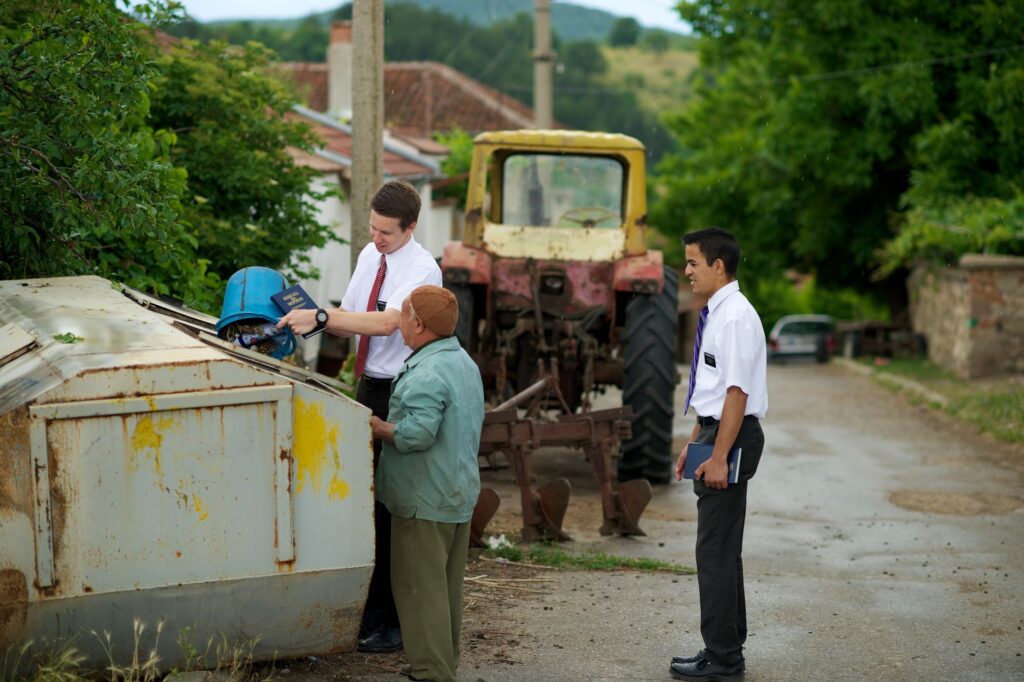
The missionaries in the area I’ve described aren’t allowed to eat at members homes and are discouraged from doing much of anything unless it involves teaching an investigator with a chance for baptism. But consider the impact of the missionaries in that area laying aside the looming question of “how many baptisms they’ll have by the end of their mission” and then focusing on strengthening the members and their families.
Do you remember when Alma gave up the judgement seat to become a full time missionary? In Alma, he went out and bore down in “pure testimony” to the people he was teaching. But many overlook the fact that Alma’s mission wasn’t to “non-members.” Alma left the judgement seat and focused his entire mission on members of the Church who were struggling.
As it was in the day that Alma left the judgement seat, there are a great deal of members of the Church who are at this time, on this day, struggling, and could have their lives changed by having missionaries in their home. To help them once again feel to sing that song of redeeming love. To help them remember how they once felt.
Alma was dedicating his life and ministry to strengthening the core. If we, as a Church, don’t need this now… then I don’t know when we will.
I know for a fact that in this area mentioned above, that there are myriads of youth struggling. Many of their parents are struggling as well. Many of the people who live in that area have moved from various places where they had missionaries in their home on a regular basis. And now they NEVER have missionaries in their home because the only way the missionaries are allowed to come inside and spend time with the members is if the member has an “investigator” there for the missionaries to teach. That rarely happens.
But what these members do have in their homes are young men, young women, and primary aged children who need to feel the spirit of missionary work. They need to see and hear these Elders and Sisters in their home. They need to hear the pages of their scriptures turn. They need to hear the testimonies of those missionaries and learn the doctrine that is taught in the scriptures and simplified in Preach My Gospel.
For every young man or young woman who is inspired to serve a mission because of the example and teachings of these missionaries, it could be worth hundreds and thousands of baptisms in a few years. These missionaries may not see the fruit right now, but their testimony will be be strengthened while in the process of teaching more often. And in all reality, they’ll probably get more referrals in the short term by building trust with and inspiring the members and their youth.
If a missionary is taught to have an impact on an area rather than to “get baptisms,” they will do things for the people in their area and for the Church as a whole that is timeless and unprecedented.
The communities of this world are in desperate need of unselfish, outward minded missionaries at the center of everything they do. Their examples can change the world even if it doesn’t lead to a baptism. And if we fail to see that… then we are failing the world. We’re failing to help every knee to bow and every tongue to confess. We’re failing to prepare the world for the Savior’s return.
In all of this, maybe the most important reason to approach missionary service in this way is for the missionaries themselves. They need to feel the joy of service. Yes, it’s good to learn how to fail. But not every day. They need to feel like what they’re doing is making an impact. They need to roll up their sleeves and do things for others that they can’t do for themselves through service. They need to be able to teach the message that they were sent to teach… even if it’s to people who technically have their names on the records of the Church. It will change the trajectory of their lives to have that kind of experience. Where they can lay their heads on their pillows at night in their sometimes dirty and dingy apartments and say to themselves, “I know I helped someone today.”
That… will cure a multitude of ills, and change a multitude of lives.
This is the way Christ served his mission. Peter said simply, that the Savior “went about doing good.” He let his love and his life speak for itself. And all he had to do from there was answer their questions. And those that had ears to hear… would hear.


This is so right on. I think that missionary work is starting to lean in this direction, but it is happening slowly and depending on the personality of the mission president.
All it takes really is a little change. The leaders of the church through Christ will make or take it in that direction officially.
I know that they have been working on it. 🙂
Christ inspires us to reach out to our brothers and sisters in love. This is thinking that’s people oriented and not baptism oriented which will bring service with pure intentions to our friends and to our missionaries. It will prepare all missionaries hearts to be servants hearts in their Wards and Communities wherever they go and isn’t that the integral eternal purpose that we are all here to develop? Thoughtful and loving article, Greg‼️
Well said Vickie. 🙂
I know that’s true. I’ve seen it changing and doing marvelous things.
Ben Franklin… Tell me I forget, teach me and I will remember, engagement and I will learn. Intelligences is the energy that powers matter in humanity. That is the next arena that we need to teach. The 3 precursor virtues for intelligence are humility, respect and gratitude. Gearing up to do seminars on Wisdom.
A wonderful article. Reminds me of you in the good old days:) Gives us food for thought.
hahaha! The good ol’ days. I’m trying to write at least more again. 🙂 Thanks a lot Martha!
Ben Franklin… Tell me I forget, teach me and I will remember, engagement and I will learn. Intelligences is the energy that powers matter in humanity. That is the next arena that we need to teach. The 3 precursor virtues for intelligence are humility, respect and gratitude. Gearing up to do seminars on Wisdom. Would like to visit you.
This is why it was so great to be a sister missionary. No trying to get promoted because there is no position to be promoted to. No competition. We could just love the people, serve them, teach them. It was a marvelous experience because of that
Ben Franklin… Tell me I forget, teach me and I will remember, engagement and I will learn. Intelligences is the energy that powers matter in humanity. That is the next arena that we need to teach. The 3 precursor virtues for intelligence are humility, respect and gratitude. Gearing up to do seminars on Wisdom. Would like to visit you.
This is exactly how I was able to serve my mission almost 20 years ago and it made a world of difference. I even had an interview with someone that was due to be baptized and I told them that I didn’t feel that they were ready and got chewed up one side and down the other by the missionaries that had put them on date. Being converted and being baptized are two completely different things. People don’t care how much/what you know until they know how much you care.
A lot of great wisdom in your comment Josh. Thank you!
I wish this was the model for ward ministering too. Instead of being assigned 3 people in the ward to visit, why not just encourage the members to find SOMEONE who needs attention, whether in or out of the church. Why don’t we enlarge the church program ministering net to include ANY child of God instead of only those in the church? And if RS pres’ or Bishops think someone in the ward especially needs regular visits, then they can orchestrate that with someone to make sure it happens. I know we all try to serve all people to a degree, but it would be even more powerful if we made that our church designed ministering program. Some are often worn out with all their duties in and out of the church, and don’t have a lot of extra energy to do more, so making this a part of the program would help people who serve ANYONE feel like they are doing good! And they WOULD be doing great good!!! And what a missionary tool!
EXACTLY!! I know the program is Love, Share and Invite, but I think members are so busy inviting that we forget Step 1: LOVE. Such a great plan. I love Greg’s article. I mean it!!
I really like that!
I totally agree that service and love are the answer. It is the answer not only for missionaries in the field but for the members in their communities as well.
Imagine a whole church, both missionaries and members literally “Just Serving.” 🙂
Yes!! I felt this way when I served 43 years ago in the South. If we just could have served in the community and shown ourselves to be followers of Christ, doors would have opened wide. But no, we had to knock on doors for 8 – 12 hours a day that rarely opened. Alma Jr. and Ammon’s example is perfect. I hope the Brethren make it possible.
They are Rozy. I know they’re working on it. It’s being implemented in various missions. 🙂
I remember those door knocking days too!
I really appreciate the power of service. My wife and I helped the community we served in use our young missionaries – they called them the heavy-lifters.
Every community needs some heavy lifters 🙂
THIS!!! Yes, exactly my thoughts. There is no better way to bring others to Christ than to reflect his character of love and priority of service. Baptism may or may not occur initially as a result, but the impression will last forever in their hearts and will eventually draw them to the gospel.
Patience right? 🙂
I love this perspective and completely agree. Numbers are an easy way to make comparisons but they are not the Lord’s way. Service can add so much depth of hope and victory to the lives of missionaries and every individual who participates.
Amen to your article! A month or so ago we had the missionaries in our home. We aren’t supposed to have them over for dinner anymore, but they can come and share a message. Before they arrived I was feeling bad that my kids were all busy and not home to hear their message and that I hadn’t found any friends to come over to hear their message either. But it turned out that I was the one needing their message that night. As they read from the scriptures and shared their simple message and testimony of Christ I felt the spirit so strongly that it brought me to tears. I felt like their message was just for me and exactly what I needed to hear in that moment. I love having the missionaries in my home and I invite them in any chance I get. I love the spirit and strength that they bring into my life which is, at times, desperately needed.
So well said Kathy! Thanks a ton for your comment!
I love this post. It rings so true. I’ve never served a mission but in my branch I work closely with the missionaries including senior missionaries. Our focus is on everyone in our small community, whether they’re members or not. We have a strong faith-based community (various Christian faiths) and it doesn’t matter whether they’re members or not. Nor should it.
That’s so great to hear Joanne!
You started this with your book–The Coming Revolution. I was just released as the Ward Mission Leader. More than once, I saw investegaters lose interest when the Sisters pushed for a baptism date during the second lesson. They wanted to pull them in before they were hooked.
Hey Bruce, it’s great to hear from you! It’s so true what you say. 🙂
Well said, Greg! Your father was a great support to me as my executive secretary with I was the Riverside
California Stake Mission President many years ago.
Hey Boyd! He’s a good man. 🙂 How’s your son Ben doing?
How I wish it was like you described. This would’ve made a huge difference in the lives of those RMs who came home disillusioned about the correlation they experienced with number of Baptisms they had, types of leadership positions they got, number of hours tracked or meetings taught, best “salesman” techniques, etc. and their perception of self- worth & success as a missionary. I know some have stepped away from the church because it felt like an institutional machine measuring them for acceptance. Are they good enough? Do they fit the mold? Did they make the team? Makes me cry. The old way isn’t especially helpful for retention of new members or missionaries either. People want authenticity. This new model could really elevate the process and be better for everyone. People don’t want to be pushed. But everyone wants to be loved.
“People don’t want to be pushed. But everyone wants to be loved.” Love that.
Your article “The Future of Missionary Work In The Church” is great insight. Thank you for sharing.
Thanks Garth! It’s so great to hear from you!
I love this post. I was a missionary in 1986-1987 and experienced exactly what you described at the outset. I didn’t have a salesperson personality and felt very uncomfortable treating my mission as nothing more than sales call. I also served in a very, very, very low baptizing mission. Back then we didn’t do much service, and I wish that we had. It would have changed the trajectory of my mission and I know many others who served with me. I sincerely hope that these changes will come.
For sure. It is beginning to happen in missions which is amazing news. 🙂
i was meant to be that kind of missionary . i witnessed other missionaries baptize ; the only baptism i performed was given me to to .
i loved the people (i could have been physically serving . ) after 60years i still do , having returned to my mission country year after year after year because i love those people . i feel that i became a failure missionary ; maybe i was .
i know i could have been more assertive , but that is not i . i had trouble learning the lessons and memorizing scripture passages and where each was . i know i could have been a better missionary if i had been permitted to do what i can DO – serve . that is how i perform today —- in ministering , and loving it because i can do it better than i can speak .
PLEASE DON’T USE MY NAME
I wholeheartedly agree with your assessment of missionary work. I served in Guatemala and El Salvador in the early 1970s. We, too, were directed to get as many baptisms as we could. Each missionary was assessed a monthly goal. If we met that goal, we were given a certificate stating as such. The end result was that in those countries there is about a 15 to 20% activity rate. We need to stress quality over quantity.
Oh dang! You got a certificate!
Love the article on future missionary work. Why not sooner?
This is exactly how I picture missionary work being effective. I served in Zambia with my husband recently. I feel strongly that service is the answer. The missionaries could be such a great resource to build up the church in countries like Zambia. The people need examples of love and service. They need to learn how to live and care for each other. This is the purpose of LOVE, share, invite. Maybe we have been doing it wrong for a long time but it’s a perfect time to change. If we made our missionaries into true ministers what an amazing difference it would make in bringing souls unto Christ. It’s the Savior’s way. He taught us how to do it so let’s get going! The Church is not being nurtured in African countries. There is so much disparity in what we have here compared to what the Church gives there. We must truly serve them and help lift them out of poverty through love. Changing the way we do missionary work to being servants would make all the difference.
Amazing. Have you shared this with those who can enact change? You hit all the right points. Thank you for your spiritual insight.
I think the change is underway. 🙂 Thanks for reading!
What makes you think it is going to change? I like your vision of what it could be.
Amen!
You once again nailed it with your message and commentary! I can personally relate to everything you’ve outlined as I have served as a missionary and faithful member throughout my life. Thanks again for sharing your wisdom and insights!
Thanks Jim! Grateful for your comment here!
You are once again spot on!!! Great job. Keep up the good work. I look forward to each of your emails.
Thanks Gregg! That means a lot. 🙂
Thinking like a jew, I don’t mind being a salesperson, It is incumbent for us to be in our heavenly father’s business. Besides, the Gospel of Jesus Christ is the power of God unto salvation and it so good that sells itself. The alternative is not good for anybody out there. All we have to do is open our mouth or unleash our thumb! I can serve an 8-10 stretch back to back as a prisoner of God. Take a two month break and do it all over again. He is the best employer I ever had. And I have had many. FYI, the devil does not pay, Never work for that company. Other employers are just fine!
Wonderful article, Greg! It’s a wonder I ever joined the church 53 years ago. It’s been pushy salesmen and women before and since. The Mr. Brown program was especially hurtful to people I loved. 40 years later, they still hate missionaries and don’t want anything to do with the church. Mission Presidents have been the main cause of elders, and occasionally the sisters, jumping out at women leaving arts and crafts stores, etc. I’ve seen it far too often. (And don’t get me started on Mission Presidents’ wives not allowing elders to speak directly to the MP about highly sensitive matters. They should not be gatekeepers.) Anyway, Service in the community would be such an improvement and might even make friends for us, something we will need by the thousands very soon. Leadership levels just need to get out of their own way.
Great article Greg. I served my “young mission” in South America (1970-72) and had many baptisms and at that time taught many many discussions. We however, were in the members home constantly, building great relationships which helped the members fellowship our investigators. Since then my wife and I have served two missions together. One mission in Spain and a local mission (housing coordinators). We saw in our last mission how difficult it was for the Elders and Sisters when they weren’t allowed to eat dinner with a member family unless they had an investigator (now “friend”) present. I underrstand the reasoning behind this requirement but aslso recognized that the members lost the rapport with the missionaries. Since the Lord is in charge of His work, I am sure changes will be made as needed to further the work. Thanks for you great articles.
I truly enjoy reading your articles and agree with everything you wrote. I am so glad to see more “service” missionaries being called. I was always so happy to perform service as a missionary! I think we can alleviate so much stress and anxiety by focusing on service. Thank you for sharing your talents, Greg. I am excited for the future you see!
I love this reminder about the true purpose of missionary work and how we, as members, benefit from having the missionaries in our home. I made it a point to feed the missionaries in our home quite regularly when my two daughters were young. Those missionaries helped inspire them both to serve missions. They both served in missions where baptisms were few and far between. But they rendered a lot of service, to members and nonmembers alike. It changed my daughters’ lives, and it probably changed the lives of people they served. Christlike service tends to do that for the giver and the recipient.
Amen brother! I served on a mission that baptized a ton of people. In fact, we were not supposed to visit members because it was considered wasting our precious time. Just a couple of weeks ago, the sister missionaries came into my home and shared their enthusiasm for the missionary work. My struggling 16, 14 and 11 year old children were so touched by their love and kindness. They were so excited about the work. That experience was powerful and I wish that more families had it. These two sister missionaries may have changed the future of my three children still at home. All from a small visit and a enthusiastic love for the gospel. Your message is exactly what is needed now more than ever!!!
Thank you so much Greg! I believe this with all my heart. I currently serve as the Stake JustServe Specialist and I feel that we, as members, could learn much from this mindset shift. Serving and loving those in our communities will bring us closer to Jesus Christ, and help us show God’s love for His children while we lift where we are. I love the thought of going to bed each night knowing “I know I helped someone today.”
Loved the article and 100% agree. Sadly, I am not sure the vast majority of Mission Presidents have received or accepted this message. Having one son who recently returned and one serving now, the number of baptisms is still very much the “KPI” that is being heavily tracked and scrutinized (along with # of lessons taught, new “friends” etc.) and the feelings of inadequacy are very much there when the mission expectations aren’t being met. Not sure where it comes from but would love to see a shift to this mindset!
Having just returned with my wife from serving as senior office missionaries in South America, your article rings all too true to me. We LOVED our sweet missionaries and our mission president and his wife, and we completely immersed ourselves in supporting and serving all of them. That said, the constant focus on goals, KPIs, putting people on date, following up, and baptisms, was for me, soul crushing. The unwritten rule that success is defined by baptisms, and that that is the sole purpose of missionary work, for me, missed the mark. There was no mechanism in place to truly support new members, and the wards and branches certainly didn’t/couldn’t take on that enormous burden, and so it became a revolving door, with far too many converts dropping away fairly quickly. For all the love we experienced and gave, and the incredible experience that our 18 months was, I was so ready to get away from that singular, constant focus on baptism. I’n not proud to say that I became very jaded and am still processing the experience. Something definitely needs to change in our missionary program.
Excellent article! I agree 100%. Thank you for your insights.
I really feel that we all need to be more loving and chuck the stats out the window. We need to recognize that we are ministers to each other through our baptismal covenant and that the assignments we receive are only a small part of loving God and loving our neighbor…
My most recent ministering interviews (as ward RSP) were just visits. I visited the ministers and ministered to them. We only talked about assignments if they came up in the course of conversation. It was refreshing and amazing, and yet I still wondered if I was breaking the rules! Haha.
I totally agree with this article and I think this attitude is a very long time coming.
I would love to discuss this more with you. My mission was exactly what you described. I was given extra training in the MTC (5 dedicated weeks worth) to learn humanitarian principles. We were trained to go in to a branch president and ask, “How can we help? What do you need in this area?” We were called “Missionaries with Additional Assignment in Welfare Work (MWAA)”
At first my mission president had no idea what to do with us (as with most MWAA, we would all just get sent to proselyte, and told we could use our extra training in our 4 hour service allotment). But after presenting the principles to him and his wife, they had my companion and me start a welfare program in our mission… which he then had us train all the sisters in the mission… and then we got asked to train all of the sisters in the neighboring mission.
I have done so much research and work on this topic (wrote a 20 page paper on it a number of years ago)… about how much more effective the entire missionary program would be if we changed the focus of missionary work to be an ammon type of missionary. Have had meetings with missionary department, etc. We have made some good headway, but in some ways it’s like turning the titanic :).
It’s always been interesting through the years to see how missions are run… my husband’s mission in Peru had the members baptize the individuals instead of the missionaries. That created a bond between the members and new members. On the other hand our son that served in Mexico, years later, his mission president would only allow them to attend the temple if they met his quota for baptisms. Needless to say there weren’t many that were attending the temple. That always hit a sour note for me; surely the missionaries would receive greater inspiration if they were able to attend the temple! It really is all about service, and establishing love for those you teach. Too many have fallen away from the church due to a lack of acceptance and love. Charity never faileth… and that’s not just for the sisters! It’s for all members!
I have grandkids in the mission field right now. This would be wonderful to implement! Then people would open doors instead of closed doors when they see white shirts coming. I know for myself, the greatest joy in life comes for me when I serve someone else. Your article is spot on.
Amen brother. I love missionary work and I’m pla Ning to serve a mission when I’m retired.
You hit the hammer right on the nail. What you’ve laid out is absolutely the true way of serving missions. When my kids were young I was a ward missionary leader. I always had 6 4 or 6 missionaries over at my house every Sunday. It was absolutely a blessing to my vmchikdren. My kids grew up respecting and enjoying our times with the Missionaries and discussed anything from sports to scriptures etc. My kids grew up with strong testimonies of the gospel to this day. I was so upset when they came up with a new rule to not have missionaries at any members home unless there’s an investigator. It was then portrayed the image of salesmen instead of church errands.
I’m so excited and thankful there’s a priesthood holder who has been inspired if what missionary work should be and looking at the dropping off in numbers of members etc. It’s very sad cos missionary work should be how the Saviour taught the gospel. Not some competition or comparison situation.
I thank you brother for voicing this beautiful and profound message and a change in missionary services. Thank goodness. ♥️
I know if we serve people by involving ourselves with the community and the neighborhood, the influence will automatically observed and being practiced.
I’m so so gkad and very appreciative of this new change.
I cant wait to bring it to our ward mission leaders weekly meeting. I’m now a ward mission leader again in our ward. Thank you verybmuch. ♥️
Love this, Brother Trimble! ….and all your great posts. You are truly a great force for good. Keep pushing…. I’m sure it will happen. I also feel another type of change is happening and will happen more so in the future through social media–am seeing many more podcasts and posts being thrown out to the world, many are very interesting and informative that stimulate and create interest (even curiosity) among our nonmember friends (of course there are negative ones also. ….we have to have the opposite in all things.)
I just wonder who they will find to sell solar products and pesticide control !
Amen! I was preaching this when I served in 89-91. I was considered somewhat of a rogue missionary. Meaning, I didn’t focus on the number of baptisms, just serving people. I knew it was the right way. Missions are changing but not fast enough in my opinion.
This article hit the “nail on the head” and needs to be read by every general authority in the church! My husband and I have served two full time senior missions, and have seen the young elders and sisters struggle to meet unrealistic “goals” for both baptisms and teaching appointments. Time for change has arrived and is overdue.
This just gave me such an uplift!! It not only applies to missionaries in the field, but to those of us who are members and neighbors to non members. Suddenly, it makes it easy to serve them and just love them. I minister to a sister who has been inactive for years and years. I just connect with her and talk and visit at the gym where she teaches a cycle class that I attend. We’ve been friends for years. I don’t know if she’ll ever ask questions, but she knows that I love her and care about her!
Yes yes yes! I’ve been saying this for years!!!
We are sending our young adults out to the mission field and they are coming back broken and burnt out on the church. Something HAS to change. Mission presidents need training in mental health and the
whole program needs a serious overhaul. Your ideas are a great place to start!
This is so refreshing! Amen Amen and Amen! When we lived in Northern CA and I served as YW President, we had a lot of kids form the h.s. curious about our youth and the missionaries when they saw them. I said back then and still say today that missionaries should help with ym/yw almost like youth pastors and wear normal street clothes w their tags. We had non member kids come to our activities and it would have been amazing for them to rub shoulders with the missionaries in a fun way. I also felt the missionaries should wear collared polo (golf type) shirts and khaki pants while proselytizing. They would be more approachable.
I forwarded this article to my son who is serving in Brazil and I received an email back saying this article has changed him. He has been struggling in a lot of ways you mentioned and every single point really hit home. Thank you for your insight and perspective.
My son is currently serving in the USA and they found a Facebook post on a neighborhood page (written by a non-member) letting everyone know that free physical labor was available from the LDS missionaries and “they aren’t allowed to say no so they’ll do anything you ask them”.
The missionaries are called to proclaim the gospel. Yes, of course to love and serve the people but also to teach the doctrine of Christ and proclaim the gospel to the world. If they’re busy loading and unloading moving vans, and mowing lawns as free manual labor then they don’t have time to do the things they’re called to do. How about the members focus on the service and help to open those doors and start those conversations.
Amen!
Amen!
Very Good article, but not revolutionary. Many of us think this way. No one of us in our culture is totally unique; so no doubt many of our top Church leaders have thought of this, too. In the 50+ years since I was a missionary in the UK, I’ve seen MANY significant changes in the Church Missionary Plan. Good improvements. You’ve described a plan that is already being implemented, church-wide, but on a reduced basis. As greater success is seen, it will be expand. May we all just do our part in Serving Where We Are Now. Thanks.
I agree with this 100%. I returned home from my mission in 1985 and honestly still have some PTSD from the whole experience. We had to keep track of every waking minute of our day in fifteen minute segments. Study time, exercise, travel time, tracting, teaching etc. There was intense pressure to limit travel and member time as if those weren’t a legitimate use of time. I think I only had one week of my mission that everything added up to 65 hours. It was mentally and emotionally exhausting. And I was an obedient, hard-working missionary. It was probably easier on those who didn’t care. In one city we had the opportunity to go into the high school and discuss the church in their religion classes. We essentially taught discussions to an entire class of teenagers. We also were invited to speak English with students in their English classes. For some mysterious reason our mission president told us to stop. We were once again out knocking on doors for hours where most were not home or resented being interrupted. I was thrilled when the church added service to a missionary’s day. I agree that more service would be amazing. I also had children serve in France and Italy. Street contacting day after day in a small town is ineffective and an invitation to depression and anxiety. Something needs to change.
I was one of those missionaries in the ’90s and I served in Scotland where I had one convert baptism – which by the way only came because we were serving a less active family and teaching this single mom with a handicapped daughter and her young son. He decided to get baptized and because he wasn’t blessed as a baby he was considered a “convert baptism”. I looked at my mission as one of my greatest accomplishments because I learned to Love God, Love others, and Love myself in such profound ways that they changed me forever. I LOVE sharing the gospel and I feel like I am more effective because I am a friend to people and when the time is right, you can share your beliefs and the Savior’s love. That is what it all comes down to, loving as Christ loved – and helping them to feel Heavenly Father and Jesus Christ’s love for them when people feel that, you impact the world!
I wish I would have had this article before my mission to Japan. Where were you in 1978 when I needed you most!
First, we were instructed to memorize the rainbow lesson plan. When we were lucky enough to teach a lesson, you could imagine the shock on our investigator’s face when we started teaching and all of a sudden this perfect Japanese came from our lips. And, heaven forbid, if Mr. Tanaka asked a question, it would break our memorized pitch and throw us off.
Second, we tracted. Every day. All day. Rain. Heat. Snow. One Sunday, after church while sitting around socializing and eating lunch with the members of our tiny branch, my senior companion told the members we had to leave immediately. That’s right, to go tracting. Ugh.
Third, my first mission president told us to a use a “survey” approach when going door to door. (“Hi, we are from America doing a survey about your feelings on families.”) I did not like it. It was deceptive and ineffective. But good practice for those missionaries who ended up selling pest control after their mission.
Greg, you did it again: you zoomed in on the essence of missionary work, ministering, and being a true Christian.
As an adult bachelor “Investigator” and “friend”, I can agree with much of what you write. I have reached out to some Church members only to be referred to young missionaries. There seems to be little interest among young adult professionals in developing a relationship with an outsider. I have visited a number of congregations in my area only to be told I must “meet with the missionaries” if I want to know more about what the Church teaches. To join, apparently one has to go through that process. I have initiated contact with a few adult businessmen who suggested we might get together, but no one followed up with me to set a time or date for a meeting. I think most are busy making money. Yesterday was probably my last visit to a wealthy Ward where I had hoped to make a faith connection. As a nonmember with years of Church experience in an other denomination, I am disappointed in the Mormon evangelism approach. (I am aware that the current Prophet does not like that term. But President Gordon B. Hinckley in his address at General Conference in the 1990s said it was okay – “more better” I think was his phrase.) Thank you for your good article and blog. Sincerely yours,
While I agree with some of the thoughts presented here, I think it’s worth noting that Ammon also asked “will you” questions when the time was right.
Greg I have been trying to find where God wants me to share my blessings, I don’t make a lot of money but wanted to give to a missionary so I looked up missionary and believe I’ve found what God wanted me to find, my birth name is Karen Trimble , please help me to help missionaries spread God’s word and bring more people to Christ